




For decades, the spreadsheet has been the undisputed king of the finance department. It’s flexible, familiar, and seemingly free. But for growing companies, that "free" tool comes with a staggering hidden cost. Research suggests that finance teams spend up to 20% of their work week, a "silent tax" on growth, simply maintaining, updating, and troubleshooting complex Excel models.
While spreadsheets offer a level of control that standard cloud tools lack, they have become a bottleneck. For many finance teams, being a "data janitor" isn't enough. Management doesn't just need to know what happened last month; they need to know what will happen six months from now if they hire a new team, lose a major client, or face a supply chain delay.
The Illusion of Control and the "Sync Gap"
Virtually every finance team is buried in Excel or Google Sheets. It is the "industry standard" by default, yet it is fundamentally flawed for modern, agile business. The primary issue is that spreadsheets are static in a dynamic world.
- The Sync Gap: Spreadsheets are rarely synced with live accounting data. The moment you export data from QuickBooks or NetSuite, it begins to decay. By the time the formulas are checked, the data is three days old.
- Fragile Logic: A single broken formula or overwritten cell can cascade through a model, leading to high-stakes inaccuracies that erode leadership’s trust.
- Version Chaos: We’ve all seen it: Budget_Final_v4_Actual_REVISED.xlsx. Without audit trails or secure collaboration, teams struggle to identify the "single source of truth."
Why "Smart" Tools Often Miss the Mark
If spreadsheets are the old way, why haven't AI-driven tools taken over? Many finance teams find that "modern" solutions suffer from two distinct problems:
- The Rearview Mirror Effect: Most accounting tools specialize in past reporting. They are excellent at telling you what you spent, but they struggle with forecasting that meets a team's forward-looking needs.
- The "Black Box" of AI: AI-driven forecasting relies heavily on historical records. However, business doesn’t always repeat itself. AI cannot account for the "human" factors—the strategic pivots, client relationship nuances, and industry intuition that management teams prioritize.
The Three Pillars of Modern Forecasting
To move beyond the spreadsheet, a finance team must bridge the gap between human intelligence and automated accuracy. Dryrun was built to master these three specific pillars:
Real-Time Connectivity
Dryrun creates a Single Source of Truth by bi-directionally syncing with major platforms, including QuickBooks Online, Xero, Sage Intacct, Microsoft Dynamics 365 Business Central, and Oracle NetSuite. This turns a three-day manual data pull into a three-minute refresh.
Weekly Rolling Forecasts
Monthly forecasting is no longer frequent enough. A Weekly Rolling Forecast allows you to see the immediate pulse of the business. It helps manage immediate liquidity and payroll while informing medium-term hiring and long-term capital investment.
High-Impact Scenario Modeling
In a spreadsheet, "Scenario A vs. Scenario B" is a nightmare of copied tabs and hidden links. Dryrun allows for Parallel Modeling, letting you see two different futures side-by-side.
Example: "If we land the Smith Contract in June, our cash position is $X. If it slides to August, our cash position is $Y. Do we have the bridge financing to survive those 60 days?"
Comparison: Spreadsheets vs. Dryrun
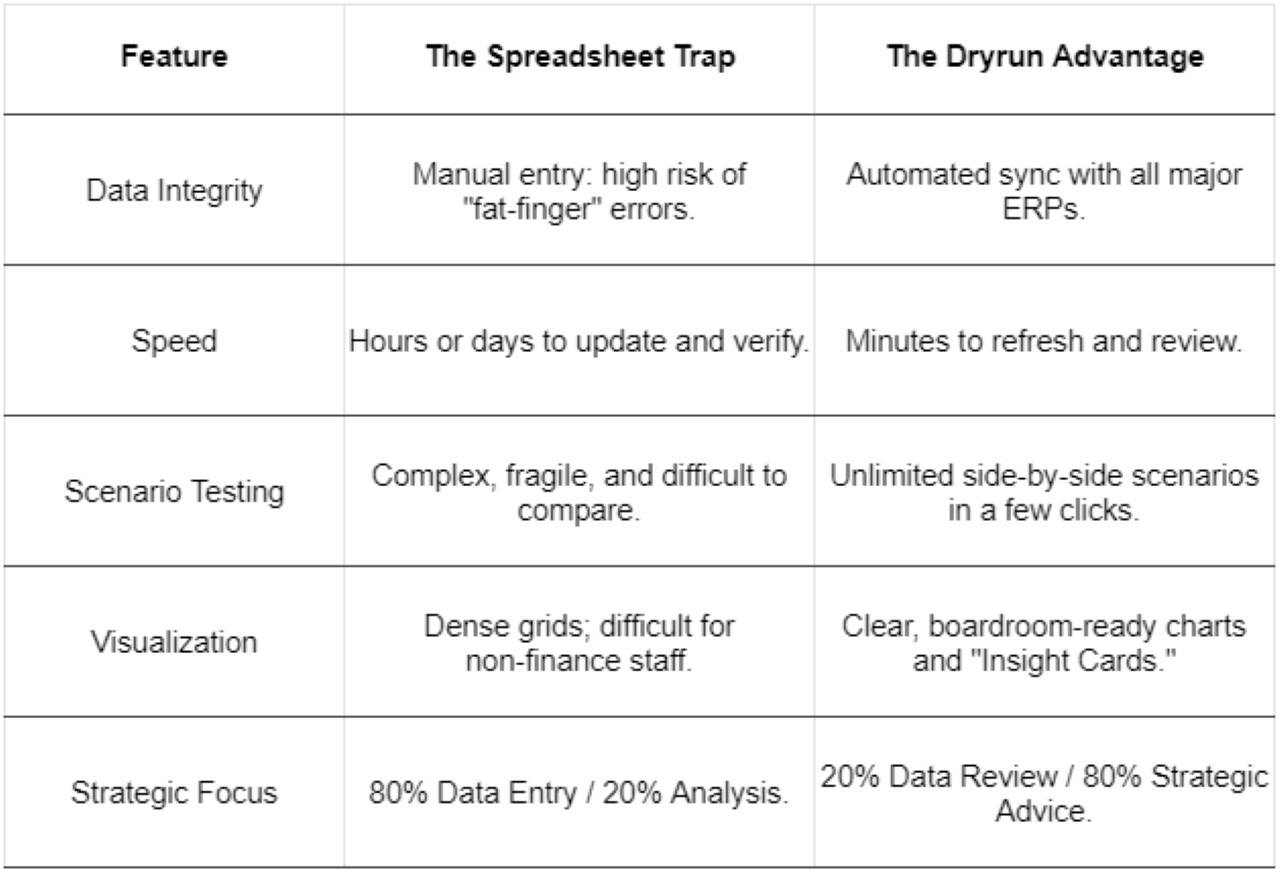
Matching the "DNA" of Your Business
For industries like Construction, Manufacturing, and Professional Services, cash flow isn't a smooth line; it’s "lumpy." You deal with large deposits followed by long periods of high burn.
Dryrun is uniquely built to match this DNA. It allows you to model project-based milestones and set specific expectations for when a client actually pays versus when the invoice is technically due. You can manually adjust any transaction, override assumptions, and layer in the intuitive factors that a machine simply cannot see.
From Reporting to Strategy
The goal of a cash flow forecast isn't just to see the future; it’s to change it. By moving away from the manual grind, finance teams move from being "data janitors" to strategic advisors.
Dryrun delivers a clear, accurate, and up-to-date forecast that management can actually read, trust, and act upon. It provides Insight Cards for instant health checks and Action Lists to turn your forecast into a to-do list, allowing you to flag overdue invoices or aged bills directly from the platform.
Stop explaining your spreadsheets and start driving your strategy.
Reclaim days of manual spreadsheet maintenance every month. Dryrun syncs your core ERP data with direct manual control so you can spot timing gaps and steer growth with confidence.
Book your demo today >>


